BIG BEAR ANIMALS
Animals abound in our mountains and some, like the playful Squirrels, Chipmunks,
Raccoons and Coyotes are a pretty common sight, however the Black Bear, Mountain
Lion, Bobcat, Fox and Deer are rarely seen. These animals are secretive and don’t
like the presence of humans. You could hike every day for years and not come across
any of them, and then one day, spot one in an unexpected place.
BLACK BEAR - Ursus Americanus
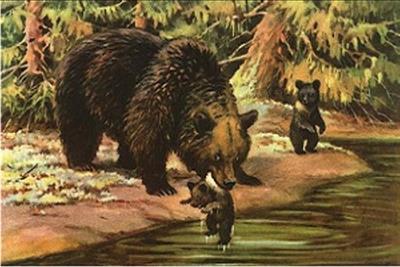
Mama Bear with Cubs
Big Bear Lake and Big Bear were named after the huge Grizzly Bears that roamed the
Valley in the 1800’s. The Serrano Indians lived in harmony with the mighty Grizzly
and thought of these huge animals as grandfathers. Bear meat was never eaten, nor
was bear fur ever worn. Sadly, by the turn of the century, the miners, loggers and
cattle grazers had killed the last of the Grizzlies in the southern California Mountains.
The only place you can see Grizzly Bears today is at the Moonridge Animal Park in
Big Bear Lake. Years after the demise of the Grizzly, the smaller, less aggressive
Black Bear was introduced into the San Bernardino Mountains.
Bears have been great favorites in zoos for hundreds of years, and it’s not hard
to see why this is so. Their great strength is impressive, and the sheer size of
some bears is enough to gain instant respect. Some captive bears are “hams” and
like to put on a show for the human spectators.
Male bears are called boars, and females are called sows. Young bears, of course
are called cubs. Sows are smaller and as a rule, and stay away from the larger males.
Only during mating season do sows and boars spend any time together. The body of
a bear may look lumpy and clumsy, but these animals are among the strongest and
fastest on earth. These powerful creatures are peaceful by nature, and usually only
fight when they have to. Black bears are small bears (200 to 400 lbs) and have long,
straight noses and the largest ears of any bears, they come in all shades of brown
as well as black.
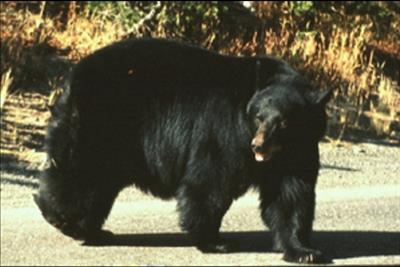
Black Bear.
Whenever they are in danger, black bears climb trees, they have
rather short claws that are ideal for scrambling up a tree trunk. Black bears spend
the snowy days of winter in a den; they may stay asleep without eating or drinking
for as long as 5 – 6 months. During the coldest part of the winter, black bear babies
are born in the den. Usually, two are born, but there can be from one to four cubs
in a litter. The babies are very small, often weighing less than ½ pound at birth.
Bears spend most of their time looking for food, which may consist of plants, twigs,
buds, leaves, nuts, roots, fruit, berries, plant shoots, ants, honey, fish, insects,
and grubs. They sometimes eat birds eggs, beehives and small mammals.
Remember, that while not aggressive, black bears will protect their food and young
if they feel threatened, so if you do happen upon one, it is best to give them plenty
of room and not create a situation where a bear might have to be unnecessarily killed.
Keep one thing in mind, they don't want you, they want your food. Take the time
to store your food correctly and never keep food on your person, in your tent or
sleeping bag. The future of bears is up to us. The human desire for more land and
resources is the main threat to the survival of bears throughout the world. We must
try to protect the wilderness and continue to set aside areas for bears where people
are only visitors – places that bears can call home.
BOBCAT– Felis rufus.
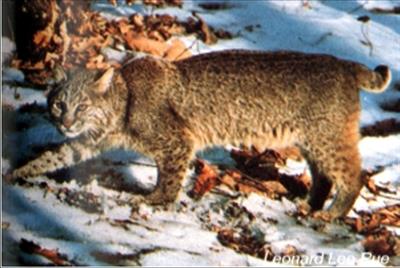
Beautiful Bobcat in the snow.
Bobcats are found in almost all types of habitat, it has the widest and most continuous
range of any California carnivore. The name Bobcat may have originated from its
short tail, which is only 6 or 7 inches long. The Bobcat has long legs, and pointed
ears tipped with short hairs. Its short fur varies in color from tawny-gray, tan
to reddish-brown and has dark spots and blotches. Adult bobcats measure from 30
to 45 inches long, including their tail. Males weigh from 18 to 24 pounds. Females
weigh about 16 pounds and are shorter than the males.
Bobcats are active mainly at night, although I have come across them at different
times of the day. They are extremely shy and quickly run away when approached. I have observed
them jumping and playing by themselves. Bobcats have keen sight and hearing, are
good climbers, effortless jumpers and can also swim. They feed mainly on rabbits,
birds, and rodents such as mice, wood rats, squirrels, and gophers.
Bobcats occupy areas from ¼ of a square mile to as much as 25 square miles, depending
on the habitat and sex of the Bobcat. Bobcats mate in late winter or early spring.
After a 60 – 65 day gestation period the female gives birth to 2 or 3 kittens, weighing
4 to 8 ounces. The young remain with their mother until late summer.
Until 1971 the Bobcat was pursued and destroyed as an undesirable predator, and
little thought was given to its status or welfare. Although there is international
protection of the world’s spotted cats, the pelt of the Bobcat can still be taken
legally. The trapping of bobcats endangers their survival and is opposed by wildlife
conservation groups. Because of the value of the Bobcat’s fur and the recent increase
in the take by hunters and licensed fur trappers, the California Fish and Game Commission
has imposed a wintertime trapping season to control the amount of time when Bobcat
can be hunted. These measures should insure the survival of the Bobcat and hopefully,
this beautiful creature will be recognized as a valuable part of our wildlife resources.
CALIFORNIA MOUNTAIN LION - Felis concolor.
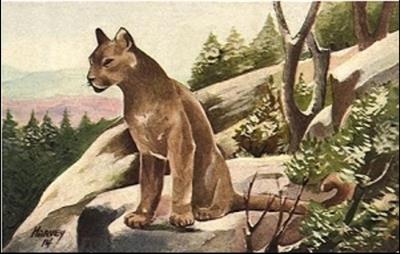
Mountain Lion.
The mountain lion, commonly known as the cougar, panther or puma (puma is an Incan
word), may be either a gray color or red or yellowish color called tawny with black-tipped
ears and tail. It is smaller than the jaguar, but is North America’s largest cat.
This animal has no spots, although the kittens or cubs are covered with blackish-brown
spots and have dark rings around their tails. The markings fade as they mature.
Adult males may be more than 8 feet long, from nose to the end of the tail (up to
5 feet not counting the tail). The body is slender, and the legs are long. The head
is round and rather small.
Mountain lions have from one to five cubs at a time, generally two years apart.
The cubs weigh about 1 pound at birth. Adults care for their young until they are
able to survive alone. Young lions need about two years to develop enough skill
to find their own food. They may live to be 10 to 20 years old. The mountain lion
usually hunts at night and preys on large animals such as deer. It travels long
distances after game in a single night. In case of need it can survive on small
mammals and other wildlife.
Despite their size and strength, mountain lions are shy and retiring, they are timid
towards people, which is why you can live in mountain lion country and never see
one. Although mountain lions seldom attack people (there is a far greater risk of
being struck by lighting), if you go hiking, try not to go alone and always keep
small children close to you. Do not approach a lion; most lions will try to avoid
a confrontation, so give then a way to escape. Do not run from a lion as this may
cause the lion to chase you, instead turn and face the animal and make eye contact.
Don’t bend over or turn your back. Avoid bending, but pick up small children, so
they don’t run. Throw stones, branches, or whatever you can reach without crouching
or turning your back. The idea is to convince the lion that you are not prey and
you may be a danger to it.
The status of the mountain lion in California evolved from that of “bountied predator”
between 1907 and 1963 to “game animal” in 1969. Since 1990 the Mountain Lion has
been protected, which reflected the public’s appreciation and concern for this magnificent
animal. We must always keep in mind that the number one killer of wildlife is the
loss and fragmentation of habitat.
COYOTE – Canis latrans
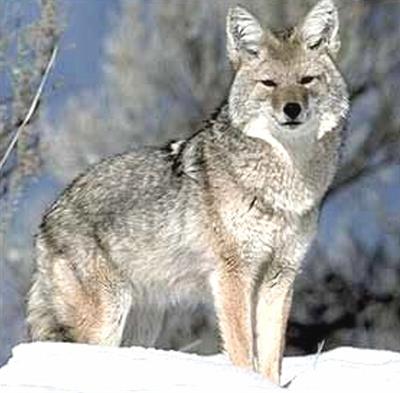
Coyote.
The coyote’s name is derived from the Aztec word “coyotl”. It is a member of the
dog family and resembles a small German Shepherd, but slimmer boned and weighing
much less, up to 31lbs (14kg), (a German Shepard can weigh up to 175lbs). An adult
coyote measures about 4 feet (1.2 meters) long, including its 11-to 16-inch (28-
to 41 centimeter) tail. Adult coyotes vary in color from light yellow or yellowish-gray
to brownish-yellow. Their fur may be tipped with black. The coyote has large pointed
ears, a narrow jaw and bushy tail. Most coyotes live alone or in pairs, but some
form groups of three or more. You can tell them apart from their larger cousins,
the wolf and domestic dog because coyotes carry their tail low when running, while
wolves and dogs carry their tail high.
Most female coyotes first mate when they are about 2 years old. Pairs mate for life
with dog-like devotion. Litters contain between 5 to 10 young, and the male feeds
the nursing female. A newborn coyote weighs from 7 to 10 ounces. The female provides
milk for her young until they are 6 – 7 weeks old. Most coyote pups can care for
themselves by late summer, when they leave their parents, but some pups may not
leave the family group for up to two years. As many as 50 to 70% of all juvenile
coyotes die before they reach adulthood, most due to human related causes.
Coyotes can and do eat almost anything: carrion, freshly killed prey, insects, fruit,
squirrels, mice, rats, gophers, rabbits, fish, frogs and other animals. Coyotes
can be observed throughout the day, but are most active at dusk and dawn. Hungry
coyotes will attack domestic cats and dogs, so don’t leave smaller pets outside
unattended or large pets outside early morning or late afternoon. Coyotes can run
at speeds up to 30mph for short distances and maintain a 20mph lope for long periods.
The coyote is known for its eerie howl. A common call is two short barks and a long
wavering yodel. It’s howling and yipping serves to communicate with family members
and to notify neighboring coyotes of its presence in the area. The coyote is a shrewd
and highly adaptable animal; it has survived trapping, poisoning and other attempts
to exterminate it, since humans first domesticated animals hundreds of years ago.
In the wild, coyotes are timid with a natural fear of humans, however they are curious
animals and may watch you from a distance.
Hopefully in the future we can learn to co-habitate with coyotes and other creatures
that, like us, just want to find a safe place to raise their young.
GRAY FOX – Urocyon cinereoargenteus
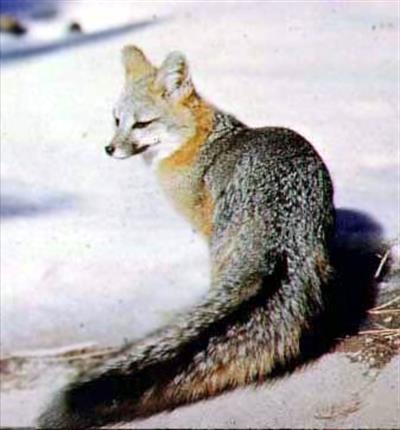
Grey Fox with a large bushy tail.
The gray fox is a bushy-tailed, sharp-snouted member of the dog family. They can
vary in size from 21” – 46” in length, including the tail. The tail measures from
14” – 16”. Most of these animals weigh from 7 – 15 lbs. The back of the gray fox
has the color of salt and pepper mixed together. The animal’s underparts are whitish.
The sides of the neck, shoulders, and legs, and the underside of the tail are rust-colored.
The tail of the gray fox has a black tip. This fox is also called the tree fox because
it often climbs trees. It has partially retractable claws. Foxes communicate with
each other using growls, yelps and short yapping barks.
Besides intelligence, the fox has keen hearing and an excellent sense of smell;
they are quick and skilful hunters. Their diet consists of rats, mice, rabbits,
birds, insects, lizards, snakes and fruits and berries in season. They hunt mostly
at night, but will sometimes forage during the day. They remain active the year
round.
Foxes are family-oriented and live in family groups while the young are growing, at other times they live
alone or in pairs. They do not form packs like wolves. Foxes mate when they are
about one year old, sometime between January and March. After mating, foxes live
in dens that can be underground, hollow logs or trees, small caves or among boulders.
The gestation period is about 2 months and the female gives birth in late winter
or early spring. Both the female (vixen) and the male (dog)protect and bring food for
the pups. The pups start to live on their own in late summer, and may wander far
from where they were born. Because the female is highly territorial, the parents
may separate then and rejoin in the Autumn or Winter.
MULE DEER - Odocileus hemionus
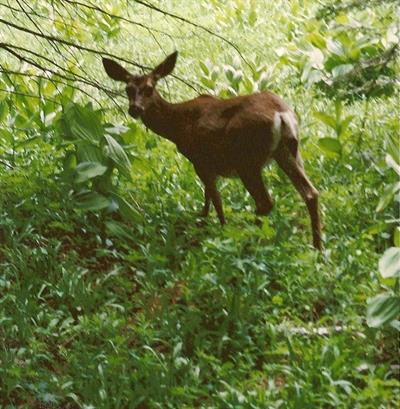
Mule Deer amoungst the Corn Lillies.
The Mule deer is a beautiful animal with large, furry ears similar to those of a
mule. The mule deer is moderately large, grayish- to brownish-colored with a black
tail. The large branching antlers are restricted almost entirely to males. The mule
deer can grow up to 6' in length and 3' to 3 ½' tall at the shoulders and is noted
for it's peculiar stiff-legged gait.It can swiftly bound over the roughest trail
much faster than the average animal. Although they have acute senses of sight and
hearing, these deer rely largely upon the sense of smell in detecting danger.
Mule deer of both sexes normally do most of their feeding in early morning before
sunrise or in late afternoon and evening before sundown, they spend the middle of
the day resting in cool, secluded places. In the winter, they may seek out sunny
places that are hidden from view with vegetation. The mule deer eats grass during
the spring, but lives on buds, twigs, leaves, berries and acorns the rest of the
year. The gestation period is roughly 210 days, and the fawning period extends over
several weeks in June, July and August. At birth fawns weigh about 2.5kg; after
about 60 to 75 days they are weaned from milk to a diet of vegetation. They reach
sexual maturity at about 18 months. Although they are a rare sight in the Big Bear
area, you have to be careful when driving the mountain roads at night as they sometimes
can be seen along the road's edge.
RACCOON - Procyon lotor
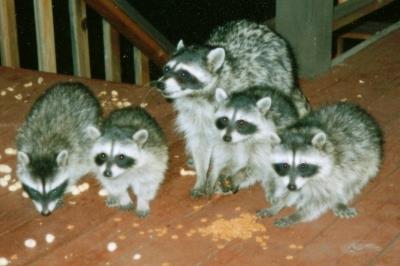
Mama Raccoon with her young kits.
Raccoons are found only in North America, and primarily in the United States. They
are furry animals with a bushy, ringed tail and a band of black hair around their
eyes. This black hair looks like a mask. Raccoons measure from 30 to 38 inches long,
including their tail, which may grow as long as 12 inches. They weigh between 12
to 25 pounds and the male is usually bigger than the female. Raccoons have long,
coarse hair that is usually grey in color, but sometimes tinged with yellow or brown.
They have a pointed snout. They have a special place in the collective body of Native
American folklore and mythology. One can't help but like this cute animal that looks
like a bandit. The raccoon is the trickster, the opponent who outsmarts his enemies,
and who uses his hands like a human. He is quick and agile, although he appears
slow. The raccoon is an intelligent and determined animal that lives alongside man
and survives.
Raccoons have highly dexterous forepaws and they have the habit of rubbing, feeling
and dunking their food in water. They live both on the ground,in trees and other
shelters. They may live alone but mostly they live in small groups. They are nocturnal,
hunting for food at night and staying in their dens during the day; they usually
live near or around water. They have strong, sharp claws and are good climbers,
swimmers, and fighters. Some people say that they will attack dogs and cats; but
several years ago, when there was an old stray cat in the neighborhood, the cat
used to eat and the raccoons would respectfully sit around him and wait to see if
he would leave anything for them. They were never aggressive with him.
In cold areas, Raccoons sometimes sleep for long periods in the winter, but they
don't hibernate. They mate between January and June. Although the female can have
from one to seven babies, she usually has three or four. She protects her young
and does not even allow the father near them. The babies stay in the den for 8 to
10 weeks, then, they begin to follow their mother while she searches for food. Raccoons
eat fish, crabs, frogs, acorns, bird's eggs, corn, fruit, nuts, seeds and small
land animals such as grasshoppers and mice. The animal's name originated from a
North American word aroughcan or arakan, which means "he who scratches with his
hands". They are linked to the dog-bear line of evolution.